Chapter 1
Introduction
Tropical cyclone (TC) generated storm surges are among the world’s most deadly and destructive natural hazards (Needham et al. 2015). These events are rare but devastating, and their hazard is increasing due to anthropogenic climate change (Walsh et al. 2019; IPCC 2021). This escalating hazard is driven by the compounding effects of an accelerating rate of global mean sea-level rise and a likely global increase in the proportion of the most intense TCs (World Meteorological Organization 2025; IPCC 2021; Oppenheimer et al. 2019). Physically-based assessments demonstrate that this combined effect will significantly increase the frequency and severity of what are currently considered rare, high-impact flood events (Lin et al. 2012). A growing portion of the world’s population lives in tropical coastal areas that can experience TCs; the number of people exposed to TCs grew by 85 million between 2010 and 2019 alone (Rentschler et al. 2023), with much of this growth occurring in the low-elevation coastal zones of developing nations (Dasgupta et al. 2007).
The standard method (see Figure 1.1) to estimate the hazard of extreme storm surges is to construct a large catalogue of synthetic tropical cyclones. This catalogue may be calculated based on statistical models of tropical cyclone behaviour (e.g., Vickery et al. 2000; Emanuel et al. 2006; Meiler et al. 2022). A substantial subset of these synthetic TCs are then used to force a physical storm surge model, such as ADCIRC (Luettich Jr and Westerink 1991; Luettich et al. 1992; Westerink et al. 1994) or SLOSH (Jelesnianski et al. 1984), to calculate the resulting storm surge. The output from the storm surge model is then used to estimate the hazard of extreme storm surges, including the joint probability distribution of storm surge hazard at different locations along the coast. Whilst this method can provide invaluable data about TC storm surge hazard, it is incredibly computationally expensive. It is also vulnerable to the structural uncertainties in the TC catalogue: If the catalogue is generated statistically, this can ignore the non-stationary effects of climate, and if it uses explicitly simulated TC climate model output it could propagate TC climate model biases.

This thesis builds upon two thermodynamic models for the upper bound of a TC. The first is the TC potential intensity model (PI), also known as maximum Potential Intensity,1 which suggests a thermodynamic upper limit on TC intensity governed by the ocean and atmosphere conditions (Emanuel 1986). The second is the potential size (PS) model which was recently proposed by Wang et al. (2022), and which we show in Chapter 2 compares favourably to observations as a plausible upper bound of a TC at a given maximum windspeed. However, we suggest that the domain of validity of the potential size model is perhaps between 10\(^{\circ}\) and 30\(^{\circ}\) latitude, as at lower latitudes \(\beta\) effects and Rossby wave radiation dominate, and at higher latitudes TCs become increasingly likely to begin extratropical transition.
By analogy we propose a new concept that uses both of these models, and call it the “potential height of TC storm surges”, or simply “potential height”. We hope this represents a significant and logical evolution in the scientific pursuit of bounding extreme coastal hazards. PI was leveraged by Mori et al. (2022) to develop the Maximum Potential Storm Surge (MPS) framework, which estimates the worst-case surge from a TC at its PI. This was a major step forward, as it provided a computationally efficient way to assess how the upper bound of surge risk might change in a warmer climate, sidestepping GCM TC intensity biases by using more reliable mean-state climate variables (Mori et al. 2022).
The concept of potential height is related to the Probable Maximum Hurricane (PMH) (U.S. Army Corps of Engineers 1986; Schwerdt et al. 1979), which defined a credible worst-case TC based on the limits of the atmosphere. This superseded the earlier Standard Project Hurricane (SPH) (Graham and Nunn 1959), which relied on a statistical analysis of historical storms to define a “reasonably characteristic” severe event. In contrast, the PMH methodology employed a ‘hydrostatic approximation’ to derive a physical lower bound for the central pressure, based on the atmospheric temperature profile, humidity profile, and height of the tropopause (see p.148, Schwerdt et al. 1979). These deterministic wind fields were then coupled with early numerical surge models, evolving from the linear “shelf” model SPLASH (Jelesnianski 1972) to the more complex SLOSH model (Jelesnianski 1992) which could account for overland inundation. This simplified storm surge modelling by giving essentially a single storm that needed to be run through the storm surge model, dramatically reducing the amount of compute needed to design key infrastructure. However, PMH was not dynamically linked to the underlying climate and did not provide a measure of likelihood, making the PMH difficult to integrate into modern risk-based frameworks (Schwerdt et al. 1979; U.S. Army Corps of Engineers 1986). Indeed, it has been superseded by modern probabilistic methods that allow engineers to accurately calibrate the design of a structure to a particular return period (e.g. Haixia et al. 2023), even though these methods can have large uncertainties in the tails (Wood et al. 2023).
The potential height of TC storm surges incorporates four key innovations. Firstly, we incorporate the recently proposed theory of TC Potential Size (Wang et al. 2022) alongside PI. This is a critical addition, as storm surge is highly sensitive to storm size (e.g., the radius of maximum winds), a factor not fully captured by intensity alone (Resio and Westerink 2008; Irish et al. 2008). The potential height framework assumes a true worst-case scenario involves a storm achieving both its maximum potential intensity, and the potential size that is possible at that intensity, simultaneously.
Secondly, we replace the idealized “worst-case track” assumption of the MPS model with a more rigorous and systematic search method. Using Bayesian optimization (as first published for TC storm surges in Ide et al. 2024), a powerful machine learning technique, the framework efficiently explores the parameter space of possible storm tracks, forward speeds, and angles of approach to computationally discover the precise combination that generates the absolute maximum possible surge at a given location, constrained by the physical limits of PI and PS.
Thirdly, we demonstrate how such estimates are useful to physically constrain statistical fits. The potential height is not intended to be a standalone, deterministic design value. Its primary utility lies in its integration with probabilistic models. By providing a hard, physically-grounded upper bound, the potential height can be used to constrain the tail of extreme value distributions (e.g., a Generalized Extreme Value distribution, explored in Section Section 3.2.5). This ensures that estimates for very long return period events do not extrapolate into physically impossible territory, thereby reducing uncertainty and increasing the scientific defensibility of the entire risk curve.
Finally, in Chapter 5 we show that the potential height framework is a source of useful test data for attempts to emulate numerical storm surge models. We create both a training dataset of ADCIRC simulations of historical tropical cyclones, and a test dataset of the most extreme events found in Chapter 4, and make both freely and easily available via HuggingFace (Thomas 2025b, 2025a). We then use the data to train a series of full ADCIRC emulators, focusing on graph neural network architectures, and we show that the more physically informed models do seem to extrapolate better to the potential height extreme test set that we have created. The models we create are proof-of-concept, suffering from severe stability issues, but by making both datasets and our machine learning code open source (Thomas 2025b, 2025a), we hope this will enable future work, inspired by the effectiveness of WeatherBench (Rasp et al. 2020).
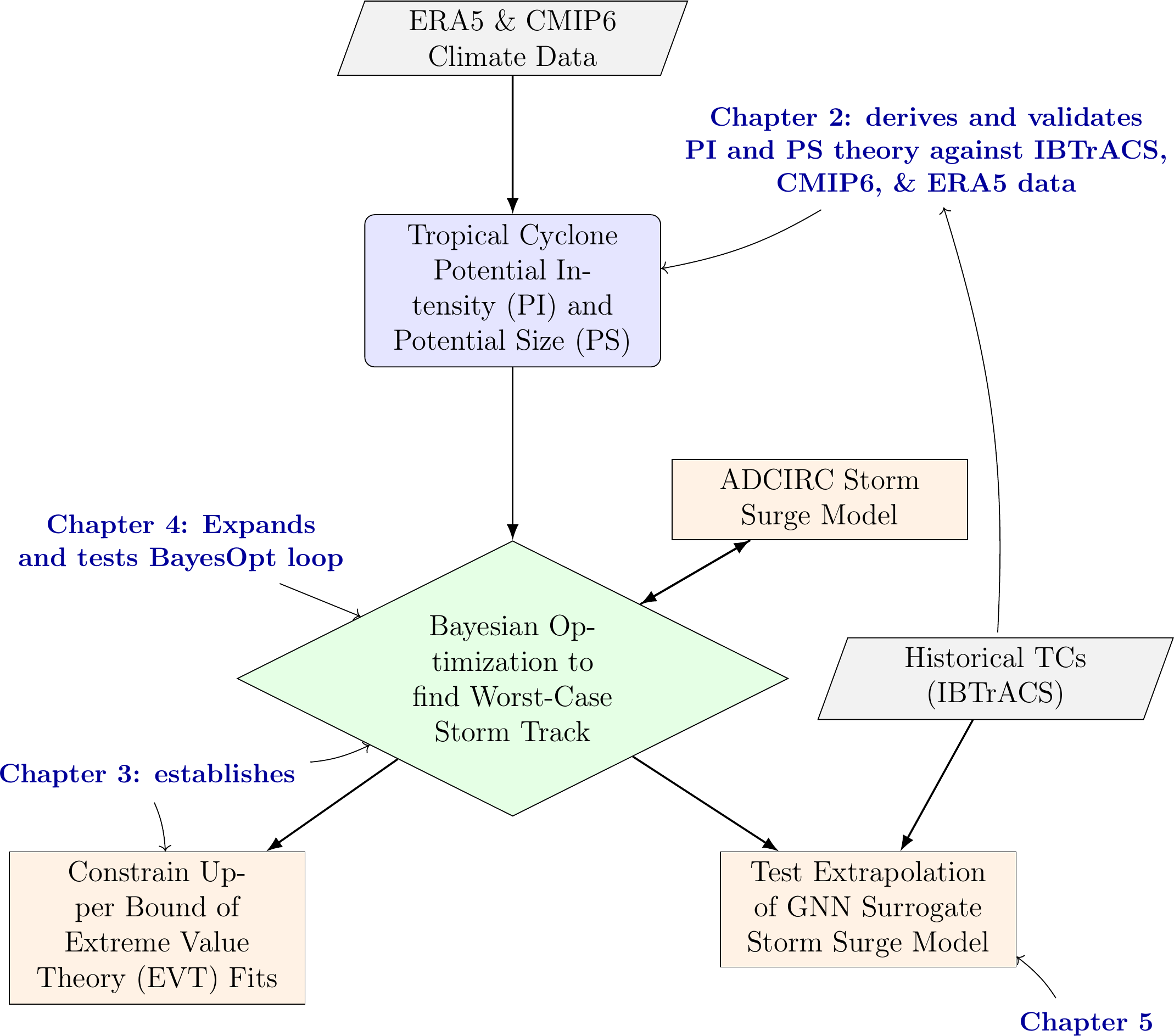
This thesis includes four chapters of primary work, which build upon each other as shown in Figure 1.2. Each chapter is written as a self-contained manuscript. They jointly present the Potential Height framework. Firstly, Chapter 2 introduces the derivation and calculation of tropical potential intensity and potential size. We compare these theoretical predictions to observations, and we then calculate how these measures increase both in ERA5 and CMIP6 SSP5-8.5. Then, in Chapter 3, which is a paper under review, we apply Bayesian optimization to efficiently find the storm track that produces the largest ADCIRC storm surge for a number of locations near New Orleans, assuming that the TC is already at the potential intensity and a potential size derived in Chapter 2. We also demonstrate that knowing the upper bound can improve our knowledge of high return period events in an idealized EVT simulation. Chapter 4 extends this along the coast to Galveston and Miami, and conducts further tests to show the robustness of the GP-based Bayesian optimization approach. In Chapter 5, we create the data to train and test a Graph Neural Network based surrogate model for storm surges. We explore the extent to which an emulator trained purely on data from simulating historical storms in the US is able to accurately extrapolate to the worst-case storms found in Chapter 3 and Chapter 4. Finally, in Chapter 6 we synthesise our findings, discuss the limitations of the potential height framework, and discuss how it might be improved and applied in the future.
References
As potential already refers to the maximum, maximum potential intensity is unnecessarily repetitive, unless it is meant to refer to a further maximum operation over say the climatic conditions of a year.↩︎